How the Venice Carnival was born
22th January 2026 - Curiosity
The origins of the Venice Carnival: when the mask became freedom
The Venice Carnival did not begin as a simple celebration, but as a moment of deep social and cultural significance. Its origins date back to the Middle Ages, when the Serenissima was one of the most influential powers in Europe. Venice was a cosmopolitan city, open to trade and cultural exchange, yet governed by rigid social hierarchies. In this context, Carnival emerged as a space of temporary freedom, where rules could be suspended.
The first official records of the Venetian Carnival date back to 1094, when Doge Vitale Falier publicly mentioned a period of entertainment granted to the people. Initially held in the days before Lent, the celebration gradually expanded, eventually lasting several months. During Carnival, Venice became a vast stage where anything seemed possible.
The mask as a symbol of equality
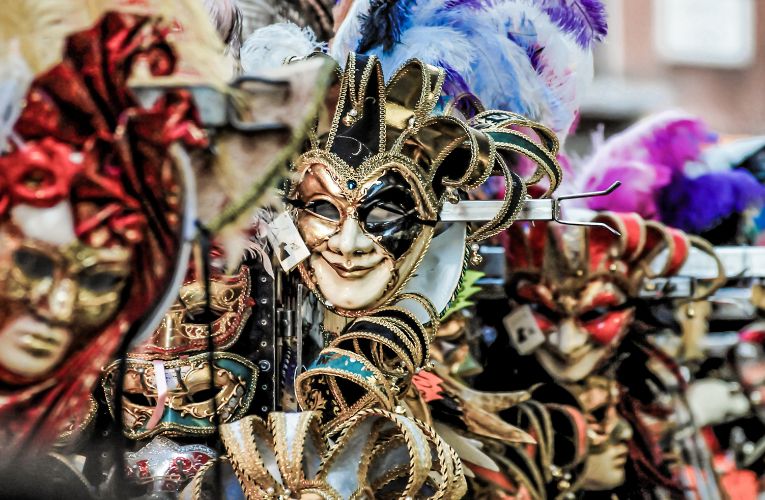
The mask is the central element of the Venice Carnival. Wearing it was not merely festive, but a political and social act. Masks erased class distinctions: nobles, merchants and commoners could move freely, speak openly and observe without being recognized. In a strictly structured society, anonymity became a form of freedom.
Among the oldest and most widespread masks was the Bauta, consisting of a white mask, a dark cloak and a tricorn hat. Its shape allowed people to speak and eat without revealing their identity. Other masks followed, such as the Moretta and the Larva. Each mask reflected an aspect of Venetian society and its relationship with power, play and identity.
A Carnival that lasted for months
At the height of the Serenissima’s power, Carnival was not confined to a few days. In some periods, masks were permitted for much of the year. Streets, squares and palaces filled with performances, games, music and private celebrations. The boundary between reality and fiction grew thin.
Alongside popular festivities, an aristocratic Carnival developed, featuring masked balls, theatrical performances and exclusive entertainment. Carnival also played a key economic role, supporting artisans, tailors, mask makers and musicians.
Control and decline
Despite its festive nature, Carnival was closely regulated by the State. The use of masks was subject to strict rules. Anonymity could grant freedom, but also pose risks.
With the fall of the Republic of Venice in 1797, Carnival came to an abrupt end. For nearly two centuries, it survived only in private and fragmented forms.
The rebirth of the modern Carnival
The modern Venice Carnival emerged in the late twentieth century, when the city chose to revive this historic tradition. Despite a contemporary approach, the connection to its origins has remained strong.
Today, the Venice Carnival is a bridge between past and present. It is not merely a celebration, but a living story that continues through the city’s streets, reminding us that in Venice, freedom has always known how to wear a mask.