The Feast of the Marie
15th January 2026 - Curiosity
The Feast of the Marie: the oldest and most symbolic tradition of the Venice Carnival
Among the celebrations that make the Venice Carnival unique, the Feast of the Marie holds a special place. It is not merely a historical reenactment, but a story of identity, collective memory and civic pride rooted in the Middle Ages. Even today, this celebration represents one of the most authentic and heartfelt moments of the Venetian Carnival.
The medieval origins of the Feast of the Marie
The tradition dates back to around the year 943, when Venice was the scene of a dramatic event destined to become legend. During a collective wedding ceremony of twelve young Venetian women at the church of San Pietro di Castello, a group of pirates abducted the brides along with their precious dowries.
The city’s response was immediate: the Venetian people mobilized, pursued the kidnappers and succeeded in freeing the young women, recovering the wedding gifts. From that moment on, Venice decided to commemorate the event every year, transforming it into a public celebration combining gratitude, devotion and a sense of belonging.
The twelve brides became symbols of purity, beauty and renewal, and the city began to honor them through a celebration that became a key date in the Venetian calendar.
From brides to the “Marie” of the Carnival
Over the centuries, the celebration took on an increasingly structured form. The real brides were gradually replaced by symbolic figures known as the “Marie”, chosen among young Venetian women. They were adorned with precious garments and jewels, funded by noble families and city guilds.
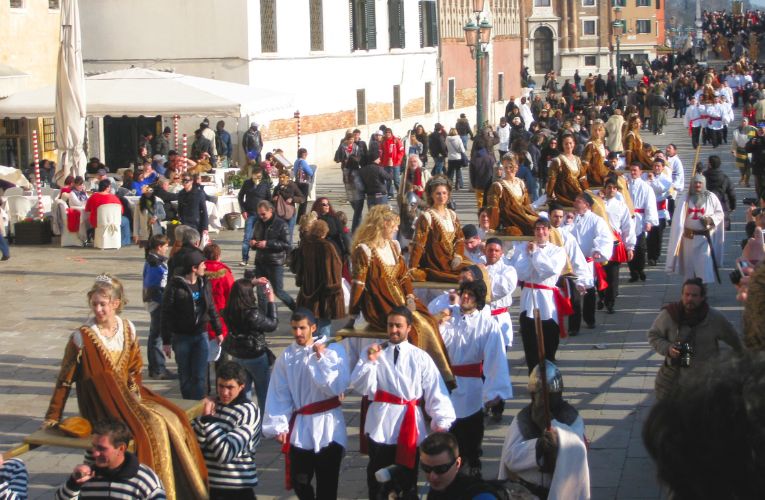
The Feast of the Marie thus became a solemn and theatrical event, with the Marie parading through streets and squares accompanied by music, performers and civic authorities, in an atmosphere suspended between sacred and secular.
This celebration was not only a tribute to feminine beauty, but also a collective ritual that strengthened the identity of the Serenissima.
Decline and revival of the tradition
With the fall of the Republic of Venice in 1797, many Carnival traditions, including the Feast of the Marie, were gradually abandoned. For a long time, the celebration survived only in historical memory.
The revival came in 1999, when Venice chose to restore this ancient tradition and officially reintegrate it into the modern Carnival program. Since then, the Feast of the Marie has once again become one of the most anticipated events.
The Feast of the Marie today
Today, the Feast of the Marie takes place during the central days of the Venice Carnival and culminates in a historical procession through the city, often ending in St. Mark’s Square. The twelve Marie are selected through a competition and wear costumes inspired by Venetian tradition, crafted with great sartorial care.
During the parade, Venice becomes an open-air theater, offering residents and visitors an immersive experience deeply connected to local history.
At the end of the Carnival, the Maria of the Year is elected, becoming a symbolic ambassador of the celebration and Venetian traditions.
The meaning of the Feast of the Marie
More than a reenactment, the Feast of the Marie represents the deep bond between Venice and its past. It tells the story of a city united in adversity, celebrating beauty as a collective value and transforming a dramatic event into a ritual of renewal.
Taking part in this celebration means connecting with the most authentic soul of Venice, a soul that continues to tell its story through tradition, year after year.